
From Technical Debt to Intelligent Infrastructure: AI’s Role in Enterprise Transformation
Digital transformation has become a defining imperative for enterprises across every sector. Yet, one of toughest obstacles remains the legacy IT estate ranging from decades-old ERP and HRMS deployments to patchwork systems stitched together over years of acquisitions and quick fixes. These systems often underpin mission-critical processes, but they are also inflexible, costly to maintain, and vulnerable to modern cyber threats.
Artificial Intelligence (AI) is emerging as a powerful ally in this transformation journey. Applied strategically, AI does not just automate processes, but also accelerates modernization, enhances cloud adoption, and addresses the deeper challenges of legacy infrastructure. For CIOs, CTOs, and IT leaders, the question is no longer whether AI will play a role in modernization, but how to leverage it responsibly and effectively.
This article briefly highlights the opportunities and risks of AI in enterprise IT transformation, with some quick practical tips, real-world use cases, and the often-neglected prerequisites of data governance, security, and change management, that must be addressed for achieving a successful transformational result.
To provide a structured way of managing a challenging transformation program, the below diagram illustrates nine aspects for consideration.
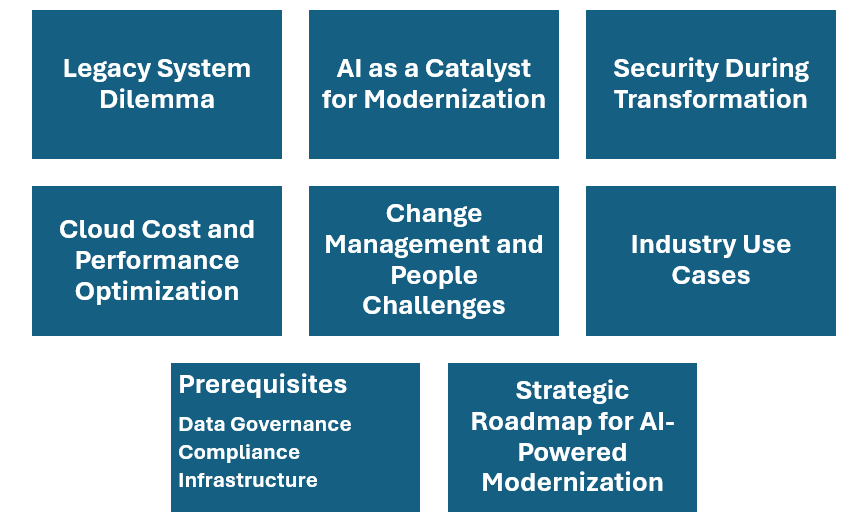
1. The Legacy System Dilemma
Enterprises often find themselves shackled by legacy systems for three reasons:
- Technical debt as old systems accumulate layers of patches, workarounds, and dependencies which an effort of rewriting or replacing them can feel like rewiring a jet engine mid-flight.
- Security vulnerabilities as legacy platforms may lack encryption, modern access controls, or timely patching, leaving enterprises exposed.
- Integration roadblocks as monolithic systems rarely communicate easily with cloud-native applications and data silos prevent enterprises from unlocking real-time insights.
For many organizations, the cost and risk of a “rip-and-replace” approach to modernization is prohibitive, so that’s where AI can step in.
2. AI as a Catalyst for Modernization
AI enables modernization in ways that were previously impractical. Some promising applications include:
- Automated code analysis and refactoring. AI tools can parse legacy codebases in COBOL, FORTRAN, or outdated Java, identify redundancies, and suggest modern equivalents which accelerate modernization projects while reducing manual error.
- Intelligent middleware. AI-powered integration platforms can act as translators between legacy applications and cloud microservices, allowing gradual migration instead of abrupt system replacement.
- Data migration assistants. AI systems can automatically map, cleanse, and normalize legacy data, ensuring smoother transfer to cloud environments. This is especially important in industries where dirty data can be a compliance and operational liability.
Tip for enterprises: Start with a pilot project where AI assists in refactoring a contained legacy process (e.g., invoice processing) and use demonstrated success to build momentum for wider adoption.
3. Security During Transformation
AI can enhance security throughout the modernization journey, but it must also be safeguarded against misuse. Some key directions include:
- Vulnerability detection. AI can analyze millions of lines of legacy code to detect unpatched flaws or misconfigurations before migration.
- Adaptive access control. AI-powered Identity and Access Management (IAM) systems can detect anomalous logins during a migration, blocking attackers who exploit transitional weaknesses.
- Defensive AI against malicious AI. Cyberthreats increasingly use AI for attacks, ranging from deepfake social engineering to automated exploits, so the adoption and use of defensive AI systems can detect and counter such attacks at scale.
Tip for enterprises: See AI security as a two-sided coin: AI can strengthen your defenses, but attackers will also weaponize it, so ensure security testing includes scenarios of adversarial AI.
4. Cloud Cost and Performance Optimization
Many organizations fear inflating cloud costs after migrating from predictable, although inflexible, on-premises systems. AI can potentially optimize this transition. Here are some typical examples:
- AI-enabled workload placement. Algorithms evaluate which workloads should run in public, private, or hybrid clouds based on cost, latency, and compliance.
- Predictive scaling. AI forecasts traffic surges and adjusts cloud capacity dynamically, avoiding over-provisioning or downtime.
- Legacy optimization. In some cases, AI may recommend retaining parts of a legacy system on-premises because it is more cost-effective or compliant.
Tip for enterprises: Implement AI-driven FinOps (cloud financial operations) early in your migration to enable better cost visibility that would prevent “bill shock” and align IT spending with business value.
5. Change Management and People Challenges
Technology is only half the battle, so enterprises must address cultural and organizational barriers. These are some indicative practices:
- AI-augmented DevOps. AI can automate repetitive tasks, such as dependency mapping, code testing, or regression analysis, and eventually free engineers to focus on architecture and innovation.
- Upskilling through AI copilots. Developers unfamiliar with legacy languages can use AI assistants to interpret and modify old code, reducing reliance on scarce specialists.
- Human-in-the-loop governance. While AI provides recommendations, human oversight ensures compliance, ethics, and contextual decision-making.
Tip for enterprises: Position AI as an enabler for staff, not as a replacement. This reduces change resistance and builds trust in transformation programs.
6. Industry Use Cases
There are several Use Cases from different industries that demonstrate the above benefits. Some indicative ones include:
- Banking & Finance. Many banks still rely on mainframes, so AI can help translate batch jobs into cloud-ready microservices and supports fraud detection in hybrid environments.
- Healthcare. AI ensures compliance with GDPR and other regulations and frameworks during data migration. It can also de-identify patient data for cloud analytics, reducing risk.
- Manufacturing. Predictive maintenance powered by AI enables IoT/cloud platforms to coexist with legacy SCADA systems, minimizing downtime.
7. Prerequisites: Data Governance, Compliance, and Infrastructure
Before deploying AI at scale in modernization projects, enterprises must establish strong foundations:
- Data Governance. Without high-quality, well-governed data, AI will just amplify inconsistencies. Organisations should first define data ownership, enforce metadata standards, and ensure lineage tracking, before even start implementing AI agents.
- Regulatory Compliance. Map data flows during migration to ensure GDPR, NIS2 or industry-specific compliance requirements are met. AI can help automate audits but cannot replace human accountability.
- Cloud-readiness Assessments. Legacy workloads vary in complexity, so plan to conduct audits to determine which applications are suitable for cloud migration, hybrid integration or modernization through AI refactoring.
- Cybersecurity Framework. Build “security-by-design” into every AI-enabled process including regular penetration testing, adversarial testing of AI models, and zero-trust network architectures.
Tip for enterprises: Treat data governance as the foundation of your AI strategy. Poor data quality not only derails migration but also compromises the reliability of AI recommendations.
8. Strategic Roadmap for AI-Powered Modernization
The journey from legacy systems to an AI-enabled, cloud-native enterprise cannot be achieved overnight. It requires a structured roadmap, where each stage builds confidence, mitigates risk, and creates measurable business value.
So, a pragmatic approach to modernization involves phased steps:
- Assessment & Prioritization. Identify legacy workloads that deliver the least business value but consume disproportionate resources.
- Pilot Projects. Test AI-driven modernization in non-critical systems first.
- Hybrid Integration. Use AI middleware to allow coexistence of legacy and cloud-native environments.
- Cloud-Native Rebuilds. Once confidence grows, rebuild core systems with microservices and AI-optimized architectures.
- Continuous Monitoring. Post-migration, AI should remain embedded to monitor costs, security, and performance.
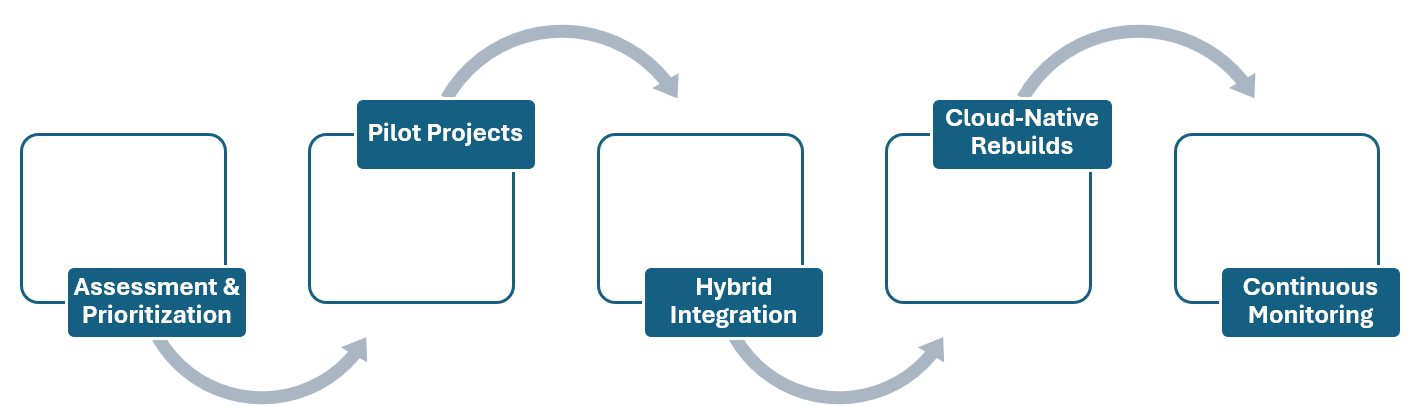
The first phase begins with Assessment & Prioritization which includes the understanding of which legacy workloads consume the most resources but deliver the least value. This diagnostic step sets the foundation for intelligent decision-making.
Next, enterprises should launch Pilot Projects. By applying AI-driven tools to small, non-critical systems, IT leaders can demonstrate quick wins, refine processes, and build organizational support for larger initiatives.
The Hybrid Integration phase enables coexistence between old and new. AI-powered middleware ensures that legacy platforms and cloud-native services communicate seamlessly, allowing modernization without service disruption.
In Cloud-Native Rebuilds, core systems are gradually redesigned into microservices and modern architectures, leveraging AI to optimize performance, security, and scalability. This phase transforms the enterprise’s IT backbone into a platform for innovation.
Finally, Continuous Monitoring ensures resilience. AI systems track performance, security, and costs in real time, enabling proactive optimization. Modernization is not a one-off event but an ongoing cycle, so AI could ensure that the enterprise remains adaptive, secure, and competitive.
9. Vision for the Future
Enterprises that integrate AI thoughtfully into their IT and cloud strategies will achieve modernization, but they will also build adaptive, intelligent infrastructures capable of evolving with the business.
This long-term vision includes:
- AI as the universal translator bridging legacy architectures and cloud ecosystems.
- Self-healing infrastructure where AI predicts and patches vulnerabilities before they are exploited.
- Convergence of AI, cloud, and cybersecurity into a single, resilient backbone for digital enterprises.
Conclusion
Legacy systems are typically seen as a technical pain, but also a critical strategic barrier to competitiveness. AI offers a pathway to modernization that is faster, safer, and more cost-effective than traditional approaches. However, success depends on strong data governance, security frameworks, and change management practices.
For enterprises embarking on digital transformation, the message is that AI is not a silver bullet, but it is a powerful catalyst. By using AI responsibly to analyze, refactor, integrate, and secure legacy systems, organizations can finally overcome the obstacles of the past and embrace a truly efficient-first, intelligent future.